Position During Conception for Sex of Baby Education
- Why is the fetal position important?
- What are the different fetal positions during pregnancy?
- What are the take chances factors for having a difficult fetal position?
- Can the fetal position be corrected?
- How is belly mapping washed?
- What are the other ways to know the position of the baby?
Why Is The Fetal Position Important?
The fetal position can determine the ease or difficulty of your childbirth. Your infant may assume one of various possible baby birth positions past the end of the gestation catamenia, which is also a deciding factor for a vaginal birth or cesarean delivery.
If your baby has shifted to a head-first position past the end of the term, they tin descend through your vaginal opening without difficulty during delivery. Even so, if your babe doesn't movement to a feasible position, your OB/GYN may decide on an alternative delivery method.
This post discusses the various fetal positions your baby may present in when you lot're in labor and its impact on the delivery process.
Dissimilar Fetal Positions During Pregnancy
Earlier the due date, your baby will drop down into the pelvis. Here are the dissimilar positions your baby can get into when you are preparing for your delivery.
1. Occiput anterior (OA)
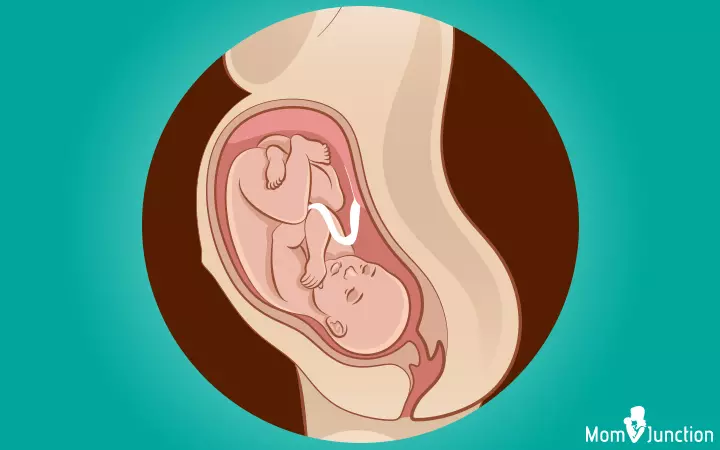
This is the ideal position your babe could achieve towards delivery. The baby moves into the pelvis with her head-down, facing the female parent's dorsum with chin tucked to the chest. Her head points towards the birthing canal. This is called the longitudinal lie.
Termed the vertex presentation of the fetus, this position is generally attained between 32nd and 36th weeks of gestation (ane). The baby volition stay in the same position for the residuum of your pregnancy. This position is considered platonic for the infant to come out of the birthing canal with head first.
There are two more than presentations in the OA position:
i. Confront and brow presentation: (2) The baby will remain in the OA position, but her face and not caput will be pointing towards the birth canal. This happens when her chin is pointing outward instead of existence tucked against the chest. The doctor tin can place this position during a vaginal examination, by feeling the bony jaws and the mouth of the infant.
In brow presentation, the baby will be in the OA position just her brow will be pointing towards the nativity culvert. During the vaginal examination, the doctor can feel the anterior fontanelle and the orbits of the forehead.
ii. Chemical compound presentation: The baby is positioned anteriorly with one of her artillery lying along her head pointing towards the birthing canal. The arms may slide back during the delivering process, just when they don't, then extra intendance needs to be taken while taking out the baby safely.
[ Read: What Is Occiput Posterior? ]
2. Occiput posterior (OP)
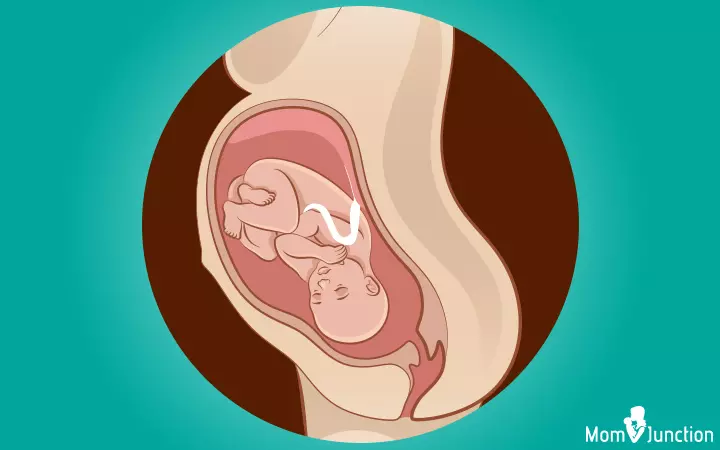
The baby moves into the pelvis with her head-down but facing the forepart/abdomen of the female parent. This position is also known as 'sunny-side up' or 'confront' position. OA and OP are chosen the cephalic or head-first positions.
Generally, effectually x-34% of babies remain in OP position during the starting time stage of labor and so plough to the optimal (OA) position. But, some remain in this position, which tin brand labor hard, resulting in emergency C-department.
This fetal position tin prolong your labor, atomic number 82 to instrumental interventions, astringent perineal tears or a C-section (3).
3. Occiput transverse (OT)
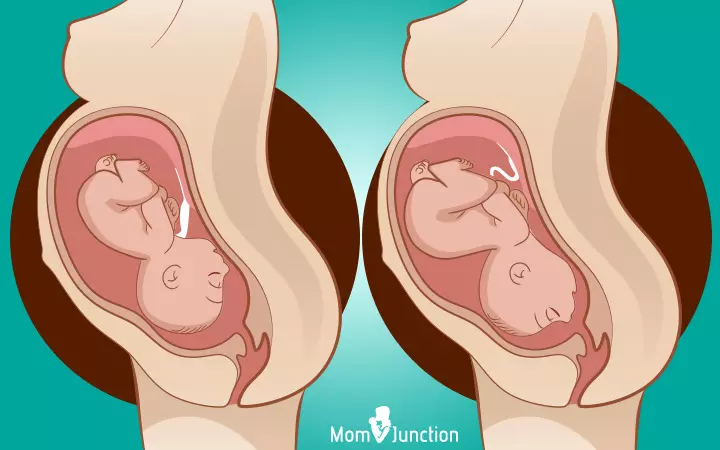
The baby lies sideways in the womb. If she fails to plough to the optimal position at the time of delivery, so a C-department becomes necessary. During the vaginal examination, the doctor can sometimes experience the shoulder, or the arm, elbow or hand prolapsing into the vagina. This position also poses the risk of umbilical cord prolapse, in which the umbilical cord comes out before the babe. Near 1% of babies in the transverse position tin can have a string prolapse (four), which is a medical emergency and needs an immediate C-section.
In some cases, assisted delivery is carried out by rotating the baby manually or using forceps or vacuum to plough the baby into the ideal position.
4. Breech position

The baby is positioned with her head up and buttocks pointing towards the birthing canal. This occurs in one out of 25 full-term deliveries. In that location are three different variations of breech presentations:
i. Complete breech: The buttocks betoken towards the birthing culvert with the legs folded at the knees and the anxiety positioned near the buttocks. This position increases the risk of umbilical string loop in a vaginal commitment. Moreover, the cord could pass through the cervix before the head, causing injuries to the baby.
ii. Frank breech: The buttocks point towards the birth canal with the legs stretching straight up and feet reaching the head. This can also lead to umbilical cord loop, causing injuries to the infant while attempting a vaginal birth.
iii. Footling breech: The infant's buttocks are downwards, with one of her feet pointing towards the birthing canal. This can cause an umbilical cord prolapse that could fifty-fifty cutting off the blood supply and oxygen to the fetus.
v. Umbilical cord presentation

During this, the umbilical string comes out first through the birthing canal (5). Notwithstanding, in that location is a difference between umbilical cord presentation and prolapse based on the condition of the uterine membrane.
Whereas a cord presentation happens when the umbilical string enters the birthing culvert earlier the water breaks, a cord prolapse occurs subsequently the water breaks, which calls for an immediate C-section.
The positions are influenced by the health condition of the mother and the infant.
[ Read: Stages Of Childbirth ]
What Are The Run a risk Factors For Having A Difficult Fetal Position?
The below factors increase the risk of fetal malpositions (6):
Maternal factors:
- In high parity women, who had more than than five pregnancies of less than twenty weeks gestations (7), the abdominal wall musculus tone fails to hold the babe in a stable longitudinal lie.
- Placenta previa, where the placenta blocks the cervical opening.
- Placenta contracture occurs when the stretchy tissues are replaced by non-stretchy tissues.
- Pelvic tumors such as an ovarian cyst or a tumor in the uterus.
- Uterine malformations similar uterus cordiformis, subseptus, or septus and uterus unicornis, bicornis, and didelphys can cause infinite restriction inside the uterus.
- Distended urinary bladder.
Fetal factors:
- Polyhydramnios – backlog amniotic fluid in the nascency sac — helps the fetus move freely in the womb, making it unstable and resulting in its malpositioning.
- Oligohydramnios – the deficiency of amniotic fluid — restricts the fetal movements.
- If the mother is conveying multiple fetuses, one or both the fetuses might change their position frequently, leading to malpositioning.
- Fetal abnormalities, such as hydrocephaly (tumors of the fetal neck or sacrum), fetal abdominal distention as with hydrops fetalis, and fetal neuromuscular dysfunction, tin foreclose the fetus from engaging properly into the maternal pelvis.
These factors increase the likelihood of having an unsuitable fetal position but yous don't have to lose hope.
[ Read: Contractions During Pregnancy ]
Can The Fetal Position Exist Corrected?
Yes. There are 2 means to correct the position of your baby. They are described below:
ane. External cephalic version (ECV)
This medical procedure is undertaken after 37 weeks of pregnancy. The technique involves rotating the baby by applying pressure on the abdomen. The doctor places ane hand over the head of the baby and the other hand on the buttocks to turn her to the optimal position.
During this procedure, the heartbeat of the baby will be closely monitored using an ultrasound. In the example of whatever discrepancy in the fetal center rate, the procedure will exist stopped immediately.
This procedure may or may not work. Studies prove that about 1 in i,000 women goes into labor later an ECV while nearly 1 in 200 women need an immediate C-section (8).
ECV is not recommended in the case of:
- Multiple pregnancies
- Unusual shape of uterus
- Recent vaginal haemorrhage
- Depression levels of amniotic fluid
- Placenta previa
- Complicated pregnancy
2. During labor
Almost babies plow to an platonic birthing position with the onset of labor. If it doesn't happen, if the babe doesn't appoint during labor, or if the shape of the pelvis is not favorable for vaginal birthing, then a Cesarean-section is performed.
[ Read: How To Ease False Labor ]
How Is Belly Mapping Done?
Abdomen mapping is a method for you to runway the position of your baby. You can exercise this from the eighth month of pregnancy. All the same, make sure to talk to your md before doing information technology.
Things you require: A marker (the ink stain should be easy to remove)
How to do:
- Lie downwardly, draw a circle on your stomach and dissever it into four parts.
- Feel the movements of the babe. Try to experience the baby's head by slightly putting pressure on your abdomen. The signal where yous feel a brawl similar feature, marker it every bit the head on your belly.
- Use a fetoscope to hear your baby'southward heartbeat and mark the point. Y'all will feel a long hard mass, which indicates the back of your baby. The heart is the function of this long mass.
- Next, try to observe the bum, which feels like a hard part. Marking this indicate on your abdomen.
- Now experience the kicks and wiggles equally they give you lot a inkling nearly the location of the baby'due south legs and knees. Mark information technology too.
- Bring together all the points you have marked to find the position of your infant.
Abdomen mapping is complicated, and you may or may not be able to track the baby'southward movements accurately. Therefore, y'all may club it with a few other means.
Other Means To Know The Position Of The Baby
Hither are a few indications:
[ Read: Exercises For Normal Delivery ]
| Indications | Probable fetal position |
|---|---|
| Feel the baby's kicks nether the ribs with your navel popping out | Anterior position with head-down |
| Feel the kicks at the front of the stomach and the tummy seems flattened | Posterior position |
| Push button the lump on your crash-land and feel the whole baby moving | The lump is the bottom of the baby. Determine the position based on the location of that lump |
| Lump on ane side that moves by itself without whatever change in the positioning of the balance of the trunk | The lump is the head of your baby. Y'all can determine the position based on the position of the lump |
| Experience the hiccups at the bottom of the abdomen | Caput-down position |
| Feel the hiccups above the omphalus | Head-upward position |
| Extreme pain nether the ribs | Head-up position |
| Heartbeats felt above omphalus | Head-up |
| Heartbeats felt below belly push | Caput-down |
These are simply an supposition and a way to get connected with the baby. They practise not replace your physician's advice.
[ Read: Baby Crowning ]
The fetal positioning is important during pregnancy and labor, as it decides how your labor will proceed. Though the babies move into various positions, at the time of labor, they might move into the optimal position. If they don't, so C-section is the all-time choice for delivery.
Practise y'all have anything to say on this? Share with the states in the comment department below.
Recommended Articles:
- When Is Your Infant Likely To Drib?
- Signs Of Labor And What To Practise
- Bradley Method Of Childbirth
- How To Speed Up Labor
The following ii tabs change content below.
- Reviewer
- Author

Dr. Sangeeta Agrawal worked in Imperial London, St. Bartholomew's, North Middlesex and Barnet General hospitals in London. Currently, she runs her own clinic in Mumbai. She is likewise attached to Bhatia Hospital, Breach Processed Hospital, Wockhardt Hospital, and Global Hospital. Her areas of expertise include obstetrics and gynecology, involving teenage care, antenatal, intrapartum, post-natal care, painless labor, fertility control, menopause... more

Shreeja holds a postgraduate degree in Chemistry and diploma in Drug Regulatory Diplomacy. Before joining MomJunction, she worked as a enquiry analyst with a leading multinational pharmaceutical visitor. Her involvement in the field of medical enquiry has adult her passion for writing research-based articles. Equally a writer, she aims at providing informative articles on wellness and pharma, specially related to... more
Source: https://www.momjunction.com/articles/position-baby-important-pregnancy_0078625/
0 Response to "Position During Conception for Sex of Baby Education"
Post a Comment